
Review of 2012: How
Bainimarama blew his opportunity to preside over a legitimate new order.
By Jon Fraenkel
In Fiji, 2012 was a year of
raised and then repeatedly dashed expectations. In January, brief euphoria
greeted the dropping of public emergency regulations, but stiff controls were
promptly reinstated several days later. In March, hopes for a relatively smooth
restoration of the rule of law and reasonably free elections before September
2014 were greatly encouraged both at home and abroad when Yash Ghai - former
United Nations envoy to Cambodia - as appointed by the interim government
to head the scheduled Fiji Constitutional Commission (fcc).
Yet by the year’s end, military commander and Prime Minister
Frank Bainimarama had fallen out with Yash Ghai and had declared the
government’s intention to extensively rewrite the fcc’s draft constitution and to avoid any public
consultation beyond that of a handpicked Constituent Assembly. Soon, plans for
the intended Constituent Assembly were also scrapped.
Throughout 2012,
authority to shape Fiji’s future constitutional arrangements remained
continually contested. Having destroyed most of the institutions associated
with the precoup order, by the end of 2012 the government was busily
dismantling the processes it had itself put in place to construct a new order.
In
his 2012 New Year’s address, Bainimarama announced that the public emergency
regulations would be dropped. Those regulations had been in
place continuously since the abrogation of the constitution in April 2009. The
announcement was welcomed by local civil society organizations as well as by
the United Nations, the Commonwealth, Australia, and New Zealand.
Yet, within
days, a new Public Order (Amendment) Decree 2012 had been introduced that
revived many of the key provisions of martial law, including police powers to
prohibit meetings, impose travel bans, and undertake house arrests, as well as
military powers to assume the roles of police and prison officers. This was the first of many incidents in 2012 in which the
interim government appeared nonchalant about its own propaganda gains and
reluctant to capitalize on any potential for re-legitimization.
Nevertheless,
the security situation remained calm throughout the year. Open opposition to
the planned Namosi copper mine, involving Australian company Newcrest and two
Japanese firms, subsided after Bainimarama himself assumed responsibility for
negotiations between landowners and mining interests and put the project on
hold. In September, there was some resumption of
exploratory activity, but care was taken to avoid
again inflaming landowner protest.
Mere Samisoni, a former parliamentarian in
the deposed Soqosoqo Duavata ni Lewenivanua (sdl)
government, was arrested in January and charged together with three others for
inciting violence, but all were soon released. In March, another sdl member of Parliament - the former
minister of education, Rewa paramount chief Ro Teimumu Kepa - spoke out against
Bainimarama’s abolition of the Great Council of Chiefs and called for UN
intervention to protect indigenous rights.
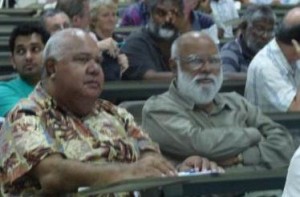 |
| FCC consultant: Jone Madraiwiwi (left) |
The central focus of anti-Bainimarama
activity was by now firmly in cyberspace, where participants had an anonymity
that encouraged abuse and ineffective rage, though here too activity quietened
over 2012. Others focused less on the polarization at the time of the coup six
years earlier and more on the fact that an ethnic Fijian leader, backed by a
predominantly indigenous military, was finally in charge of Fiji for the long
run, unlike after the 1987 and 2000 coups when military rulers had felt
pressured to hand control quickly back to civilian authorities.
Economically,
Fiji’s 2011 recovery from the slowdown of 2007–2010 weakened slightly in 2012.
The Asian Development Bank (adb)
and the International Monetary Fund (imf)
estimated economic growth at around 2 percent in 2011, but both anticipated a
slowdown in 2012. The economy was awash with
liquidity, but investment remained low due to fears about the political
situation and constant changes in regulations.
Visitor arrivals in 2012 were
slightly down from the previous
year, but at around 650,000 the industry was still
booming. Ironically, Australian tourist arrivals had kept Fiji’s economy afloat
throughout the years after the 2006 coup, while Canberra’s sanctions had sought
to sink the Bainimarama regime.
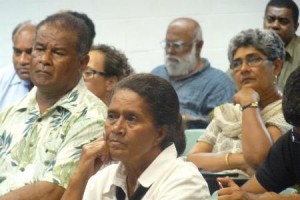 |
| Submissions made in good faith |
The
chronic decline of the sugar industry continued. Industry Permanent Secretary
Lieutenant Colonel Manasa Vaniqi pointed to reduced Fiji Sugar Corporation debt
levels since the government took over the industry in 2010, but at 1.6 million
tonnes, output in 2012 was half its 2006 level. According to the International Monetary
Fund, the industry now comprises only 2 percent of Fiji’s gross domestic
product.
Sugar’s
share of formal employment remains higher, but the still regularly quoted
figure of 200,000 people (close to a quarter of Fiji’s population) being
largely reliant on cane farming or milling is now a great exaggeration. Figures
released in 2012 by the Fiji Bureau of Statistics indicated that gold
production continued to increase through 2011, buoyed also by higher international
prices.
There was no sign of the bottled mineral water industry slowing
production in response to the 2010 increase in export duties. Garment exports
remained flat and fisheries exports stagnated through 2011. Data released from the
2008–2009 Household Income Expenditure Survey suggest that 31 percent of Fiji’s
population is living in poverty, with hardship levels particularly high in
rural areas.
Internationally,
2012 was a year of busy diplomacy for Fiji, triggered in part by broader
geopolitical realignments. In August, United States Secretary of State Hillary
Clinton touched down in Rarotonga, Cook Islands, for the Pacific Islands Forum
summit, a further sign of the enhanced US attention now being given to that
annual event.
Otherwise, President Barack Obama’s “pivot” or “rebalancing” toward the Asia-Pacific has meant little for the Pacific Island states, except for a new United States Agency for International Development (usaid) office originally planned for Suva but then relocated to the Papua New Guinea capital, Port Moresby. By contrast, Beijing’s soft loans have enabled Chinese firms to bid for construction of hydroelectric dams, roads, and low- and medium-cost housing in Fiji, as well as other infrastructure projects.
Otherwise, President Barack Obama’s “pivot” or “rebalancing” toward the Asia-Pacific has meant little for the Pacific Island states, except for a new United States Agency for International Development (usaid) office originally planned for Suva but then relocated to the Papua New Guinea capital, Port Moresby. By contrast, Beijing’s soft loans have enabled Chinese firms to bid for construction of hydroelectric dams, roads, and low- and medium-cost housing in Fiji, as well as other infrastructure projects.
Once a foothold is established, those firms are
well placed to make other acquisitions, as with Xinfa Aurum Exploration’s
bauxite venture in Bua on Vanua Levu, which commenced shipments in June. For China,
Obama’s thinly veiled China-containment policy emphasizes the necessity of
courting allies, no matter how small or remote. In September, Wu Bangguo, the
chair of the National People’s Congress Standing Committee, touched down in
Fiji. He saluted policies of noninterference, encouraged a “Look North” policy,
and criticized the “bullying of big region strong countries over the small or
weak countries”.
Over the 2011–2012 period, Fiji opened missions in
the United Arab Emirates, South Africa, South Korea, Brazil, and Indonesia. In
September, Fiji’s Permanent Representative at the United Nations Peter Thomson
was elected to chair the g77, a UN
body representing 130 developing nations, drawing protests from the
International Trade Union Confederation. In November, Bainimarama was selected to chair the London-based
International Sugar Organization, an industry body representing over eighty
sugar-producing countries. Overseas diplomacy regularly featured persuasion
about the righteousness of Fiji’s domestic reform agenda and assurances that
Fiji was following its much-advertised roadmap toward elections in 2014.
Meanwhile,
at home the Bainimarama government ruthlessly pursued its opponents, often on
highly personalized issues. In August, deposed Prime Minister Laisenia Qarase
was sent to prison for a year on nine charges of corruption, an action that one
former senior military officer and onetime ally of Bainimarama said had always
been central to the military commander’s objectives.
Oddly, the
convictions were not for offenses committed during Qarase’s period as head of
government (2000–2006) but for minor misdemeanors a decade earlier when he was
director of Fijian Holdings Ltd (fhl),
an indigenous company that thrived under the post-1987 coup affirmative-action
policies for ethnic Fijians. Qarase had applied for fhl shares for three Fijian companies but had failed to
declare his personal interest in the companies.
His
sentence was twelve months, to be served at Suva’s Korovou prison. Around 300
supporters turned up outside the court to mourn the incarceration of their
former leader. Charges against Fiji’s other major pre-coup party leader,
Mahendra Chaudhry, were also pursued in the courts during 2012. In
addition to prison sentences, by the end of the year there were clear signs
that Attorney General Aiyaz Sayed-Khaiyum was actively seeking other methods of
harassing both of the main rival political parties as they geared up for the scheduled
elections.
In theory, the trials
of Qarase and Chaudhry were free from government control. Yet, as indicated in a
report titled “Fiji: The Rule of Law Lost” from the Law Society Charity in the
United Kingdom (2012), Fiji’s courts were plagued by political interference,
particularly at the behest of Attorney General Aiyaz Sayed-Khaiyum. In July, on
his departure from Fiji after serving two years as resident justice of appeal,
William Marshall qc sent a
petition to Bainimarama complaining about “progressive inroads into the
independence of the judiciary which process has culminated since mid-April 2012
in a judiciary which at all levels now does what it perceives as required of it
by the Executive” and urging the dismissal of the attorney general.
In
March, Bainimarama set out plans for deliberations on the new constitution,
which were to be premised on several “nonnegotiable” but “universally
recognised and aspired to” principles: these were “a common and equal
citizenry”; ‘secular state”; ‘removal of systemic corruption”; “independent
judiciary”; “elimination of discrimination”; “good and transparent governance”;
“social justice”; “one person, one vote, one value”; “elimination of ethnic
voting”; “proportional representation”; and a “voting age of 18.”
Most of these
could easily have been embraced by any of Fiji’s postindependence governments,
with the exception that ethnic Fijian governments after 1987 flirted with ideas
of a Christian state and supported retention of colonially bequeathed communal
representation (whereby each community voted on separate electoral rolls).
The
idea of a military government setting any “nonnegotiable” provisions was
rejected by many, but aside from these two issues the principles themselves
were fairly uncontroversial. In comparison with the deliberations of the
2007–2008 National Council for Building a Better Fiji, the
2012 constitutional review was to generate much more broad-ranging
participation.
Optimism
that the review would lead to the restoration of democracy was greatly
increased by the appointment of Professor Yash Pal Ghai to chair the Fiji
Constitutional Commission (fcc).
Ghai had taught Fiji’s Attorney General Aiyaz Sayed-Khaiyum in Hong Kong and
had worked on both the Kenyan and Nepalese constitutions. Aside from
Ghai-nominee South African lawyer Christina Murray, the other three members of
the fcc officially sworn into
office on 25 July were much more closely associated with the Bainimarama
regime: these were community activist Penelope Moore, deposed minister in the
1987 Timoci Bavadra government and Bainimarama loyalist Satendra Nandan, and
former education minister Taufa Vakatale.
As an interim government–appointed
body with so many known regime sympathizers, the commission inevitably faced
challenges to its credibility. The legal setting was also uncertain. Previous
court rulings in March 2001 and April 2009 encouraged the view that the 1997
constitution might still be deemed legally operative or resurrected, thus
obviating the need for any new constitutional review. Ghai accused those
raising such criticisms of turning a “blind eye to reality”: “We have a
situation where there has been military rule for a while and the only way it
seemed to me to return to a democratic system is to engage the whole country in
a process of dialogue, consultations, finding some consensus”.
Professor
Ghai was no stranger to Fiji politics. He had played an influential role in the
establishment of the Citizens’ Constitutional Forum, a local non-governmental
organization, in the wake of the 1987 coup. He and his wife, Jill Cottrell, had
written extensively on Fiji, urging an “integrationist” perspective aimed at
bridging divisions between ethnic communities while rejecting “consociational”
approaches that treat “communities as corporate entities,” but seek to engineer
top-level compromise.
They were critical of the 1999–2006 alternative vote
system, despite this being the central “integrationist” instrument of the 1997
constitution. They also disagreed with the post-1997 power-sharing experiments,
pointing to the unlikelihood of robust coalitions being forged between racially
demarcated groupings. Their 2008 article ended by noting Bainimarama’s
integrationist objective and stating not unsympathetically: “If this is
achieved, the pendulum will have swung to the opposite extreme from past
preoccupations with race. And Fiji’s fortunes may then tell us something more
about the relative merits of consociation and integration."
At
the time of that writing, Ghai was obviously unaware that he would himself
become a key instrument of the Fiji government’s integrationist orientation in
2012. With a modernist military government in office, the constraints that had
prevented the 1995–1996 constitutional commissioners from dismantling corporate
representation were now gone (otherwise, the ideological differences were not
so large).
In other respects, however, conditions were much more inauspicious,
particularly with regard to continued censorship and restrictions on public
meetings, but also because the commission members themselves had not been
selected by any elected authority. Early on, Yash Ghai made it clear that some
concessions would be necessary from the interim government, reminding them that
he had walked away from the Kenyan Constitutional Review Commission in 2004.
In
July, the Bainimarama government issued two decrees, one setting out the
functions and powers of the fcc
and the other establishing the intended Constituent Assembly. The first, with Yash Ghai’s oversight, included provisions for a
suspension of the need for meeting permits under the Public Order Act during
the fcc deliberations.
The second,
without Ghai’s oversight, set out that the Constituent Assembly scheduled to
deliberate on the fcc draft would
comprise members, and a chair, appointed by the prime minister to “reflect the
diversity of the people of Fiji,” including government, registered political
parties, faith-based organizations, representatives of employers, members of
the business community, trade unions, farmers and members of rural communities,
Republic of Fiji Military Forces, national organizations, women, persons with
disabilities, youth, pensioners, and “other Fijian-registered representative
civil society groups.”
It also made provision for vetting the draft after the
deliberations of the Constituent Assembly by a five-member tribunal appointed
by the chief justice. Both decrees set out requirements for far-reaching
immunities, covering involvement in all three of Fiji’s coups, including the
ethno-nationalist coups of 1987 and 2000.
A
day after the release of those decrees, the fcc
issued a press release expressing its concern on three key points. First, it
pointed out that the decree gave the prime minister “full control over the size
and composition of the Constituent Assembly” and as a result that “essential
principles of democracy are ignored and the independence of the assembly is
negated.”
Second, it contested the firm requirement that far-reaching immunity
provisions be entrenched in the new constitution, urging instead that
deliberation on these issues become part of the constitution-making process.
Third, it indicated concern about continuing “controls over the media and
wide-reaching powers of the security forces,” claiming that these were
inhibiting the constitution-making process (fcc
2012a). Such willingness to criticize the government served to enhance the
credibility of the commission both within Fiji and abroad. Overseas
money - including support from Australia and New Zealand - began to flow generously
to fund the activities of the fcc
secretariat.
Relations
soured badly between the fcc and
the interim government during the second half of 2012. In August, Bainimarama
accused Ghai of meddling in Fiji politics and criticized the fcc for providing a “running commentary”
on its deliberations and giving “preferential treatment to certain segments or
individuals in society who they meet privately”. As the public hearings and submissions
gathered steam, the fcc processes
captured the public imagination. In total, the commission was to receive over
7,000 written submissions - attracting a greater interest than any of Fiji’s many
previous constitutional public dialogues (although the 1995–1996 submissions
and hearings were also extensive).
Many
of the submissions to the fcc
applauded the 2008 People’s Charter, which by 2012 had become the primary
symbol of support for the Bainimarama government. Some submissions were hostile
to political parties, including those by Krishna Datt, a former Fiji Labour
Party (flp) minister in the
deposed 2006 government, and Jale Baba, the former campaign
director of Qarase’s sdl party. There were proposals for an elected president, most of which were
oblivious to the ramifications of semi-presidential systems with both powerful
prime ministers and presidents (the Pacific Islands have no experience of such
arrangements).
The chiefs of Rewa strongly criticized presidential arrangements
as facilitating dominance by a “singular or individual subjective authority” in
a submission that otherwise conveyed mainly the “feeling of insecure
hopelessness, accompanied by great difficulties and anguish” of indigenous
Fijians in the Rewa Delta.
The
two largest parties in the pre-coup parliament - the largely Fiji Indian–backed flp and the largely indigenous
Fijian-backed sdl - were highly
critical of the constitutional review process. Both lodged submissions that
showed how ill equipped they were to set out any broad alternative for the
nation. The flp urged a reversion
to the original proposals of the 1995–1996 Reeves Commission, including even
the abandoned multi-member alternative vote system and 26 communal seats (10
for Indo-Fijians, 12 for ethnic Fijians, 1 for Rotuma, and 3 for the “others”).
Yet this entailed a share of seats well in excess of the Fiji Indian proportion
of the population, around 35 percent by 2012. The submission justified this by
claims that “the Indo-Fijians can rightly claim to be the most aggrieved
community” and because the “suggested distribution would give the minority
community greater confidence about their own future in Fiji."
The
sdl submission challenged the
Bainimarama government’s “bigger agenda to plunder Fijian resources by
weakening the apex of Fijian institutions.” Its recommendations were also
narrow and communal in focus. In submissions before the fcc in Suva and Nasinu in August, party representatives
urged that Fiji be declared a Christian state, that same-sex marriage be
outlawed, and that some communal seats be retained.
In a more careful submission in October, the sdl
reiterated but also elaborated on those demands. Fiji was urged to adopt a New
Zealand–style mixed-member system, with 46 open constituencies and 25 communal
constituencies.
The latter were to be divided into 14 for ethnic Fijians, 9 for
Indians, and 2 for the others, a distribution more advantageous to the indigenous community than that
urged by the flp. The communal
constituencies were to use the list-proportional representation system, whereas
the 46 open seats would be decided on a first-past-the-post basis. More
logically, this would surely have been the other way around.
In
the Fiji context, the call for a Christian state was hugely controversial. The
ethno-nationalist agenda after 1987 had been to urge the declaration of a
unitary state religion, often encouraged by the militant wing of the Methodist
Church. Since the 1987 coup had ousted a largely Fiji
Indian–backed government, such calls were viewed by many inside Fiji as aimed
at further eroding Indian rights. By contrast, as Yash Ghai rightly pointed
out, a “secular state” did not mean an irreligious state but rather a
separation of church and state and the freedom to practice whatever religion
one chose.
Data
released in 2012 by the Fiji Bureau of Statistics from the 2007 Census
indicated that Fiji’s population is 27.9 percent Hindu, 6.3 percent Muslim and
64.4 percent Christian. Nearly all Hindus and Muslims are Fiji Indian, and 99 percent of ethnic
Fijians are Christian, helping to explain why fixing singular religious labels
on the state is so inflammatory.
Changes in proportions are also hugely
significant. The equivalent figures from the 1996 census were respectively 33.7
percent, 7 percent, and 58 percent. Thus, in tandem with the increasing Fijian
population share, the country is becoming more strongly Christian.
(Interestingly, the Methodist share among Christians has fallen significantly,
from 62.4 percent in 1996 to 53.7 percent in 2007.)
In
October, Bainimarama responded angrily to the fcc
appointing former Vice President and Bau chief Ratu Joni Madraiwiwi as a
consultant. The interim prime minister alleged that Ratu Joni was party to a
submission to the fcc urging a
Christian state, contrary to the “nonnegotiable principles” set out in March
that required “a secular state,” and that he had done so while serving as an fcc consultant.
In fact, Ratu Joni had only participated
in a delegation as a Bau chief and had not endorsed the contents of that
submission. Ratu Joni is well known in Fiji as liberal by political persuasion
and, although indigenous, as highly sensitive to the concerns of Fiji’s Hindus
and Muslims. In July, he had expressed the view - not shared by many other
observers - that ethnic frictions were waning in Fiji: “We are still a fractured
society although I also have to say that ironically, inter-racial relations
appear to be better than they ever were”.
The
attack on the fcc over
Madraiwiwi’s appointment - one of many red herrings that ostensibly drove Fiji’s
political processes over 2012 - was to provide the pretext for a thoroughgoing reworking
of the scheduled constitutional review process.
On 31 October, a new decree
canceled all public consultation on the fcc
draft, removed the fcc’s powers to
detail necessary changes in law associated with the new constitution, and
demanded that the fcc detail its
income and expenditures. Yash Ghai responded by telling
reporters that the government had lost its enthusiasm for the constitutional
review process.
He revealed that there had been “massive interference” by the government in the
work of the commission.
The
Republic of Fiji Military Forces belatedly made its own submission to the fcc
in December. This recounted at length a heroic history of the rfmf’s defeat of the ethno-nationalist
uprisings of 2000 and conveyed some degree of bitterness against the entire
civilian political order: “We [the rfmf]
have been collectively marginalized, sanctioned and ‘kicked in the gut’ one too
many times.” The submission was critical of the “West Minster” model (sic) and said that the alternative vote
system had “given all in Fiji nightmares.” It urged a 46-seat unicameral
parliament and a president selected by Parliament. The key passages focused on
the guiding role of the armed forces to ensure “good governance.” It said that
there was “an enveloping comfort that the Forces exist to deal with both the
Internal Security situation and external threats.”
Echoing battles from the pre-coup
era, the submission insisted on the retention of a provision contained in the
1990 constitution giving the rfmf
“the responsibility . . . to ensure at all times the security, defence and well
being of Fiji and its people” (rfmf
2012). The reference to the “well-being” of Fiji’s people could, of course,
mean responsibility for just about everything. The rfmf envisaged itself as having huge powers, but for usage
in a “guardian” role rather than through assuming direct responsibility for
government.
In
December, Ghai handed over the fcc’s
199-page report to the president. The draft contained all the non-negotiable provisions set out in the
government’s July decrees, including the provisions for immunity. It entailed
Fiji returning to a more strictly Westminster constitution, but with some
unusual features. There were no provisions for a second chamber.
Nor were the
1997 constitution’s multiparty cabinet power-sharing provisions to be restored.
A 71-member Parliament, larger than that favored by the interim government, was
to be elected for a four-year term by a closed-list,
proportional-representation system, with provisions for a French-style “Law on
Parity” requiring parties to alternate men and women on their lists.
On the
advice of Norwegian electoral specialist Kåre Vollan, this was to be
facilitated through a mixed-member system, with 60 members of Parliament
selected from four constituencies and another 11 “top up” members also to be
selected by closed-list proportional representation. The objective was to
achieve a very exact proportionality between seats won by, and votes cast for,
political parties, but the cost was considerable complexity. Compensatory
mixed-member systems are better suited to usage of two different types of
voting system (eg, where a list component adjusts for the nationwide
disproportionality generated by a single member district plurality system, as
in Germany and New Zealand).
The
integrationist centerpiece of the constitution was to be a National People’s
Assembly, with powers to elect the president of Fiji. This was to meet annually
and bring together politicians, local government representatives, civil society
organizations (including the Great Council of Chiefs), and a group of ordinary
citizens chosen by lot to deliberate on the affairs of the nation.
There were a
very extensive bill of rights, provisions for a consultative forum on land
matters, and requirements for legislation on political parties and local
government. Most controversial were the transitional provisions, which would
have entailed Bainimarama and his cabinet surrendering power to a Transitional
Advisory Council prior to the scheduled elections. All military officers (bar
the commander) would have had to resign their commissions if they chose to
continue as public servants.
The
approach of seeking to build popular momentum behind the constitutional review
had temporarily reinvigorated Fiji’s beleaguered political scene. Indeed, the rfmf’s own submission said that the fcc review had “brought about a sense of
belonging culminating in a national pride of want and togetherness which we
must continue to foster”.
Yet for Bainimarama, Aiyaz Sayed-Khaiyum, and a few senior military
officers, this had also proved hugely challenging to their now well-entrenched
authority. In response, as in the wake of the 2009 Court of Appeal judgment
pronouncing the government illegal, they again resorted to using the president
as a mouthpiece for a dramatic reorientation.
On
10 January 2013, Fiji President Ratu Epeli Nailatikau addressed the nation,
describing the Ghai draft as backward looking and claiming that the commission
“has unfortunately perhaps succumbed to the whims of the few who have an
interest in perpetuating divisions within our society.” To adopt the draft, the
president said, would lead to “financial and economic catastrophe and ruin.”
Nailatikau had a particularly negative assessment of the proposed National
People’s Assembly, which was to have been the body charged with electing Fiji’s
future presidents. It was “anathema to democratic representation that the Ghai
Draft allows for, at the very least, a 144-member body of unelected people
deciding on key issues pertaining to the people of Fiji”.
This
was an extraordinary outburst, entailing condemnation of the key instrument of
the government’s own strategy for re-democratization. The logic was also hard
to figure: the government controlled the appointments to the Constituent
Assembly, which according to the July decrees could itself have amended the
draft. The chief justice also had a final say, through a five-member tribunal.
Clearly, the government saw risks associated with the popular momentum that had
built up around the fcc and wanted
to firmly reassert control. Yet picking this option meant that Bainimarama had
blown his opportunity to preside over the creation of a legitimate and durable
new political order.
The attorney general’s office would rewrite and revise the
draft in 2013, removing the National People’s Assembly, further fortifying
immunities and amnesties, taking out all concessions to hostile forces, and
setting in place cast-iron methods for the commander and his chief lawmaker to
closely supervise the transition - if there was to be any meaningful transition
at all.

63 comments:
Dear Fraenkel, we do not wish Bainimarama or any of his illegal cronies to preside over anything!! They were not elected through a ballot and they will never be elected come 2014. Fiji does not need self-serving liars and idiots to run the country to ground. 7,000+ submissions were made during the Ghai saga, what has been the result? Fijians were taken for a merry ride and we have been force-fed a constitution and bill of rights that is far removed from its supposed intention. A Bill of rights is what it should represent, power of the people against tyranny of the govt, sad to say this is used to deceive the Fijians into believing its protection when nothing could be further from the truth. We are not deceived and we will not take this lying down. Call the elections tomorrow Bainimarama/Khaiyum & co and see the power of the ballot.
Frankel,
Good summary of events and some good observations. I am more interested on your take on one hand the political parties opposition to the Ghai led consultation on the draft constitution and then the criticism when it was dumped.
Secondly, your views on the opposition to the new draft yet the desperate attitude by the same political parties to get registered and run for elections under the consitution that will be finalized and adopted.
Lastly, can you pls advise if the power vested with the PM under the proposed constitution is common with elected PM or presidents.
So now its confirm that Jag is really a con artist. I note his unethical behaviour while employed at TFL.
It just confirms what I had said earlier about his con investment proposal and the evidence that there was no deal with FEA.
Jag has stopped commenting on RPC's Facebook page as it became obvious that they were and are still mates in crime.
I believe only reason all political want to fight election under this so called constitution draft by arsy/baini because they have no choice. No one want bloodshed in the country or baini would have been running along casava patch and kattu arsy hiding under naz and saaz' panty.Also there are good bunch of stupid poeple supporting this jungle dictator and they will get legitimacy free for all. So plan is to go fight and chuck this constitution into ass of these two traitors and later big chuttar party in Naboro..
"If you think of yourselves as helpless and ineffectual, it is certain that you
will create a despotic government to be your master. The wise despot, therefore,
maintains among his subjects a popular sense that they are helpless and ineffectual."
: Frank Herbert
"Meaningful transition"? You're kidding, right?
The only transition that will be meaningful is Bainimarama's transition to the grave. Otherwise, the only transition we will see is Fiji's transition from absolute dictatorship to an even more absolute dictatorship.
COME ON FIJIANS
IT'S TIME TO ACT.
FIRST BULLET- for the criminal BAINIMARAMA
SECOND BULLET - for the second criminal Aiyaz Kaiyum.
ITS TIME TO FINISH THEM OFF.
There is definitely one thing that Frankel confirms....that is, Voreqe's inability to keep his promises.
1.In 2000, he failed to keep his Oath Of Allegiance as a military officer by supporting the Speight led coup
2.When he didn't get want he wanted he again failed his Oath to the people by committing further treason against Ratu Mara in Dakuibeqa. He illegally assumed executive authority and abrogated the 1997 constitution then appointed an illegal PM in Nailatikau.
3. After 56 days he was forced to step down and hand power back to civilian rule by Speight & group.
4. In 2000, he failed to keep his promises of honoring the Muanikau Accord.
5. He failed to keep his promises to Shane Stevens leading to the 2000 mutiny.He failed to keep his promise to protect his men by running away through the tavioka patch.
6.Up to 2004 he failed in his promise to senior military officers by attempting to overthrow the newly elected SDL government because they could not give him immunity from crimes. He purged all of his senior officers from 2004 because they did not agree with criminal intentions of further treason.
7. He failed to keep his promises to the people of Fiji,"saying he will maintain the rule of law and there will be no more coups".He committed treason.
8. After 2006 he has broken every promise to those who believed that he was genuine about removing corruption and bring a more democratic system of governance. Look what happened to all of them..Peoples Charter committee,FLP IMG ministers(Choddo &co), Father Barr,Driti,Yash Ghai and so forth...all got burnt.
There are so many instances which confirms Bai as a deceitful character. He is a compulsive liar and yet there are suckers who believe his every word and want to jump on the illegal wagon.
Jon,those who want to wrestle with the pig only gets muddy but the pig is always be happy...!!
The lesson here??? Public non committal to any initiative by the illegal regime or recognise them in any way.
One sure method of bringing a halt to this illegal regime is for everyone to stop paying taxes to them..it can be done!! Approach your employers to stop taxes being deducted from your hard earned wages.It is your money so you have every right to decide what you want to do with it. This also applies to private business owners and companies who should also refuse to pay taxes to the illegal regime.Every law abiding civil organisation should help in implementing this form of non violent but effective strategy protest.
REMEMBER THIS!!! Regardless of all the fancy trimmings and so called "tags of legitimacy" from Bainimarama and thugs...they are an ILLEGAL and CRIMINAL ORGANISATION!!!!!
THEY MUST NEVER,NEVER,NEVER,NEVER BE GIVEN IMMUNITY FROM PROSECUTION!!!!!
HOW ABOUT WE CALL THEIR BLUFFF???
The regime's is a sorry record of treason and duplicity. Fijians have the duty to resist treason and to wage revolution, but they slumber on in a grog-induced stupor, even as their house burns to the ground.
mick beddoes would make a good pm.at least better than aiyaz oh sorry i mean the cassava patch king.what corrupt and uneducated thugs.
Annon 6.56am
Pls not Micky mouse. This man wants to show that he is very clean and ethical but dig deep and see how he treats his workers. But importantly, he had a loan at NBF and records show that he was paying peanuts until recently when he had the means and money to pay it off a long time ago. What does it mean? We paid it through out taxes as govt had to borrow funds to pay the depositors.
Jon. Appreciate your article. Could you let us know what Fiji growth was for the years 2007,2008,2009,2010, 2011 & 2012. Also inward investment figures for those same years?
Fijian army have let fiji down.fiji people are weak they dont stand up to the injustice of fmf.
muslim are 6 % they have taken up all govt top jobs and boards/others.
So, Mick Beddoes was making minimum payments on his NBF loan. BFD! For that reason, you'd rather have traitors, murderers, liars and thieves as your leaders, instead?
One question to Khaiyum? are you going to contest election under your own draft constitution?
Frank got cold feet at the last minute because he knew there was still widespread opposition to him and his government.
****NEWS FLASH******
Kaiyum won't contest election, he'll resign and move overseas.
He's sticking to that old saying "quit while ahead".
VODAFONE ANOTHER REGIME-ARSELICKING THIEVING COMPANY:
Your views
Tebara Buses unable to meet e-ticketing deadline
Tebara Buses unable to meet e-ticketing deadline
Publish date/time: 08/05/2013 [17:07]
Tebara Bus Company said they will not be able to meet the deadline on all buses to have the E-ticketing systems installed by May 17th.
Next Friday is the deadline for all buses around the country to have the systems installed.
LTA CEO Naisa Tuinaceva said buses who fail to comply by next Friday will not be allowed to operate.
Tebara Bus Company Director Arvind Maharaj said the deadline is unrealistic and they will not be able to meet it.
He said they are talking with LTA on this matter.
He also said they are talking with Digicel to provide the services which they are offering at a lower price.
Meanwhile, Shore Buses Limited Director Jasper Singh said they are doing the best they can under the current constraints in relation to the full implementation of the E-ticketing systems in their buses.
When asked on whether the systems are installed in their buses
Singh only said that they are doing the best they can under the current constraints.
Singh has also revealed that huge savings can be made if there are more players in the market.
He said more than 100% savings can be made with a potential service provider for the electronic ticketing system.
Singh highlighted that the potential service provider will charge 2% of their sales revenue for the transaction cost per annum while the competitor charges 4.5% for the transaction cost per annum.
Singh highlighted they can get the machine for half the price at about $600.
He also said that the provider is providing the internet charges for $20 per bus per month compared to the competitor who is providing it at $45 per bus per month.
We have asked Digicel these questions and they are expected to reply later today.
LTA will also speak later today.
Story by: Sofaia Koroitanoa
Tell Khaiyum to go overseas where getting a bullet is easy as becoming the AG of an illegal regime.......
bwahahahahahahahahahahahahahahaha!!!!!!!!!!!!!!!!!! graham davies crying foul of Coup4.5 in his column on Fiji Sun.
graham davies and other foreigners ripping fijian tax payers you'll be skinned alive by the fijian people. watch it
Dear Aslam Khan / Nalin Patel
As chair and deputy chair of Air pacific can you explain the following :
what feasibilty did we do to buy airbus? with such a small fleet why there a need for both boeing and air bus
Did the board consider the extra cost of having 2 different types of fleet
why r we still having so many experts with such huge perks eg weekly travel hm and return to Aust, extra accomodation cost and meal cost in denarau, huge entertainment cost and the same time we r cost cutting which r affecting staff morales....poor inflight services etc etc
Nalin – why cant you get an analysis done how much experts are paid and their related benefits and how much savings we can done
Aslam – Is this how you operate Vodafone
Nalin – Is this how you operate your firm G lal
Or is there a separate rul for govt entities
Why cant those positions be replaced with local where possible
you may choose to ignore these question...may i ask you how can u get a decent sleep with so many blunders done and still happening
look at your inner conscience...would you be able to answer the future generation
all i can say its still not too late...GOD save airpacific
Regards
RAJESH
Well Aslam runs Vodafone and the whole Telecomunication industry.. whatever he wants form the ATH board is granted... and Telecom Fiji Limited always be the one been downgraded... Most of the wrong investment in TFL is the result of it been pushed down from the TOP... that is why Taito Tabaleka left as Aslam did not like him..same as Radrodro Tabuatalei... Well the connection is evident with the Transport minister THE A.G.....
Aiyarsehole must be prevented from fleeing Fiji, he must face the courts for all the corrupt dealings and activities he engaged in. If he is allowed to escape then he will end like Rajesh blogging from Auckland and enjoying the fruits of illegal gains, dodgy dealings etc before fleeing the country. He must be stopped at the border.
Annon 9.48am
I never implied I prefer the current regime over Micky mouse. I however, strongly feel that he does not display good governance and his self interest over the good of the nation is very clear from his behaviour to his NBF loan.
Also, his opportunist behaviour is well known to those around him. Lest I not say more about his pussy (not mouse) behaviour.
Meanwhile the shit has hit the fan at USP. A widely circulated document details the system of patronage, culture of bullying by senior staff and management, cover ups, and denial of staff entitlements in breach of USP policy that thrives under VC rajesh chandra.
Favouritism by the VC of certain staff such as angela jokhan, promoted to assoc. professor despite her pathetic research record.
Document exposes rajesh chandra for the dishonest and unethical leader he is by breaching the confidentiality of those who provided jim references for jokhan's appointment.
God of USP rajesh chandra wants everyone to follow rules but broke all rules himself in appointing angela in another sign of how he has lowered standards at USP.
Alienation of some staff who won't tow the line, gross wastage of colossal amounts of money on legal fees, payouts and consultancies, and senor management living it up on excessive perks and salaries as well as expensive retreats at posh hotels.
Meanwhile USP management is very stingy when it comes to to upgrading student facilities and dismal internet quota, and staff claims and entitlements which are rejected and denied in breach of policy.
It is all the handiwork of salulu VC and naked emperor of USP Rajesh Chandra, and cronies like Jai Karan, the hopeless markting and development director, and equally disastrous deputy VC esther williams, a proven liar.
Everything rajesh chandra did at usp was for his own benefit and image, finally some staff have had enough and his selfishness and arrogance have come back to bite him in the arse.
The fiji economy has grown every yesr except 2009 due to GFc and despite the natural disasters that hit the country. In fact, despite the stance taken by aust and nz, fiji has performed reasonably well.
Off course, it could be better and regime basher will have a field day but the facts show there was economic growth, albeit a low growth.
To BC had the IG had an expansionary fiscal stance as advocated by Keynes and adopted by the SDL, growth would be higher and so would be debt.
@Anonymous 6:11
You are right.
The problem in Fiji is INCREASED DEBT but NO GROWTH.
The only thing growing is these criminals backpocket.
The ineptitude of this Illegal Military Regime is shocking.
Just look at the farked up building in Raiwai.
Lots of money down the drain at FHL; FSC; FNPF etc etc
The fiscal incompetence of this regime knows no bounds.
Their stupidity can be seen by Bainimarama's call for gumboot for all the students.
Honestly where does this guy pulls his stupid ideas from?
editor,
Fiji's Prime Minister Commodore Voreqe Bainimarama has taken his leadership craft to such a lofty height that he is now able to advice the UN on what its priority should be. ('Bainimarama calls on UN for progress of south' Fiji Times 9/5). The UN has taken the first step in recognising the Commodore's leadership by appointing him to Head the G77. The next step should be to appoint him the UN Secretary-General when Ban Ki Moon's term ends. Not only Fiji but the whole world can then benefit from Bainimarama's leadership.
sincerely,
rajend naidu
sydnet
"So long as the people do not care to exercise their freedom, those who wish to
tyrannize will do so; for tyrants are active and ardent, and will devote themselves
in the name of any number of gods, religious and otherwise, to put shackles upon
sleeping men" : Voltaire.
"Unthinking respect for authority is the greatest enemy of truth.": Albert Einstein
The price of apathy towards public affairs is to be ruled by evil men: Plato
Hello!! G77?? Group of failures. talk about birds of a feather. So Bainimagana is the best of the failures..
Hello!! G77?? Group of failures. talk about birds of a feather. So Bainimagana is the best of the failures..
Hello!! G77?? Group of failures. talk about birds of a feather. So Bainimagana is the best of the failures..
G77. what a waste of taxpayers money.
what's the damage this time?
G77. what a waste of taxpayers money.
what's the damage this time?
G77. what a waste of taxpayers money.
what's the damage this time?
G77!! REALLY?? WHAT A GROUP OF LOSERS. AND FOR BAINIMAGANA TO BE THE BIGGEST LOSER - HOW FITTING.
G77!! REALLY?? WHAT A GROUP OF LOSERS. AND FOR BAINIMAGANA TO BE THE BIGGEST LOSER - HOW FITTING.
G77!! REALLY?? WHAT A GROUP OF LOSERS. AND FOR BAINIMAGANA TO BE THE BIGGEST LOSER - HOW FITTING.
HA HA HA G77
No one should read too much into the USP petition against VC Rajesh Chandra, which is a conspiracy making by some disgruntled and demoted staff in the Faculty of Arts and Law, and like-minded academic staff in the Faculty of Science and Technology involved in a conspiracy against the VC and plotting against Dean Angela Jokhan. Those involved in this smear campaign will soon be exposed.
@May 9, 2013 at 12:58 PM orRajesh or however you are.
Facts;
1.B 747 was costing Air Pac $1.5m per month in lease patyment. For the past 12 years we have paid $216m in each 747 we have leased.
2. New A330 is saving Air Pac 40% per passenger mile on fuel. No brainer in getting rid of old panes
3. Preference was given to Boeing but they could not deliver. Air Pac got pad damages. We could not allow ourselves to continue to lose money so immediate fix was to get a readily available A330. We needed to upgrade our fleet ASAP.
4. Fiji Pilots got the boot for their ill disciplined behavior A B 747 was helped up at airport as the pilot and reserve pilot were both drinking at Ed's bar til 4am. $00 passenger had to check in to hotels costing Air Pac $120k. Due to union rules, pilots could not be fired.
5. On Aslam Khan, simple fact, best CEO in Fiji.
6. Voda has 500,000 plus connection only 300 staff, Profit $90m per annum on average.
7. Telecom, 32,000 connection with 3000 staff. Profit/Loss around $5m per annum. Lets do the sums.
8. Aslam is worth every dollar he is paid.
Sorry, USP smear campaign against VC Rajesh Chandra Dean Angela Jokhan is inside plot by disgruntled and demoted staff in the Faculty of Business and Economics (not Faulty of Arts and Law) and in the Faculty of Science and Technology.
Watch this space. All will be revealed soon
ASLAM IS REGIME-ARSELICKING THIEVING BUSINESSMAN:
E-ticketing regime will lead to monopoly - Reddy
Publish date/time: 09/05/2013 [17:07]
Commerce Commission Chairperson Dr Mahendra Reddy has today said that the current E-ticketing regime will lead to a monopoly situation.
Dr Reddy said this needs to be fixed......
dear aslam fan
how do you explain this
everyday glitches of the new air bus
how do justify another celebration for 2 nd air bus
inreased insurance premium for air bus
2 separate set of staffs for air bus and boeing
reduced support from qantas
the main one u still hav not answered
how do u justify such hefty pay and benefits for expats...how can they afford to live in denarau hotels full time...how can they get free flights every week back home and return
why cant they be replaced by locals
how do they get away explaining expenditure on corporate cards when we employees suffer with peanut increments
does vodafone has similar benefits...m.sure no
Anon 7:37,
You seem to be giving excuses just to justify the decision for the Airfuss but seem to be (purposely) stating misleading comments. Past media statements and press releases clearly state that the 747 and 767 were always going to be removed from air pacific, this decision to return the 747 and 767 was made long ago, before the departure of ex-ceo Campbell. This then leads to the choice of planes to take their place. It is a simple mind that thinks that of all the planes available the Airfuss was the only one available "ASAP". For every plausible reason for choosing the A330, there are many more to justify a Boeing alternative. The A330 was not purchased as is off the catalogue for "ASAP" delivery, but made with air pacific specifications, same exactly what would have happened if say a Boeing 777 was chosen. So why not a Boeing then? The one person who can justify the Airfuss has left, so...
How much damages did air pacific get paid?
If those pilots were drunk then they should have been fired. So what stopped air pacific from doing that? Union rules? Blah..
No doubt aslam is a good business leader maybe he could be the new ceo?!
Airbus owner
there will be no transistion for fiji
'Aslam Khan is best CEO in Fiji', what a bloody joke. Worst is more like it. vodafone profited by gouging the public blind with exorbitant charges while enjoying a monopoly for years on end.
vodafone got a head start in the market and benefited from protectionism. Put aslam in an open market and he will shit in his pants.
This prick is not a ceo in the real sense, only in his own mind he is best. He was just the head of what was once a monopoly. nothing exceptional about ripping off public and making obscene profit in a monopoly.
This dick head thinks we are stupid.
I agree with fraenkel except for the part where he says that any past govt could have imposed all those non-negotiable principles - including common roll. He says that only after 87 until 98 was a govt in place that would not have allowed it. On the contrary, Mara had an opportunity to introduce common roll in 1975 when the street commission made it's recommendations to that effect but he rejected it because he saw that intro of common roll would lessen his stranglehold on power which he retained until 1992, under 2 separate constitutions and which under both he believed in Fijian leadership being guaranteed by a constitutional order that made it hard for Fiji Indians to gain power even though on 2 occasions in 77 and 87 he was proven wrong. And when Mara supported an indian government in 99 it was only out of spite for rabuka who liked less than chaudhry. So in short, past govts never wanted tom implement common roll even when they had the chance to
@May 9, 2013 at 9:05 PM
If Aslam Khan was so stupid and benfitting from Monopoloy, why are cleint WAF moving network back to Vodafone. our fleet using vodafine vehicle tracking, much better and realible than Digicel. Even Digicel now admitting, Fiji fight much harder than what they ever expected. After 5 years, Digicel has only 10% of corporate makret. That in itself is proof enough on the quality of CEO. I giess there is a lot of jealousy and racism vented against Vodafone CEO. Very typcial when non itaukei do well in Fiji and oput itaukei's out to the lceaner like Tabaleka was put out to the cleaners.
@May 9, 2013 at 8:10 PM
Name me one local who with international exposure justifiable of the job?
Locals at management have been caught from stealing duty free airline alcohol, to delaying planes due to own lateness to airport to upgrading family members to business from as little as $10.
And i am not saying expats are perfect either. But a lot better and efficient than local management staff.
At. Anon 6.24 n BC,
For pm to buy gumboots for school kids cannot be explained through keynesian economics or whether more or less spending is good for fiji's economy. I by the way agree that Keynesian economics is the best way forward for Fiji but with equal emphasis drawn from lessons of third way economics followed in Australia n nz and from us n uk in 1990s n 2000s.
To buy gumboots is to show his compassion as a politician, albeit he did what he did in 2006.
To think that he cannot be compassionate towards the needs of such kids is a craven way of looking at things and speaks volumes about your view about compassion in politics and in ur own personal lives. Have a heart for those kids it seems they have not caught a break that you obviously have as shown by pouting your Keynesian beliefs.
@May 9, 2013 at 8:28 PM
777 had a 4 year lead time.
A330 had a lead time of 18 months.
So decision was a no brainer.
Plus Airbus come up with an offer that could not be refused in term of $'s plus maintenance for 5 yrs was thrown in for free. Air Tahiti Nui has same plane thus maintenance wise, cost wise for airbus, it wasn't a big issue.
As for two sets of staff, we will from October will only have two types of aircrafts being B737 and AB330.
Short haul = B 737
Long Haul generally = A330
Even before, B 737 pilots never flew a 767 or 747. As far as cabin crew are concerned, they are very easily interchangeable. By early next year, the entire air pacific cabin crew (non pilots) would have ability to fly on both types of aircraft.
As to recent issue with windshield problem, it is a teething problem. Do note that Air Pac isn't the only airline flying this plane. There is around 800 of these panes in the air at present and successfully flown by the likes of award winning airlines like Emirates, Korean Air. Qantas
are u saying we cannot find locals for CFO Position...maybe ceo yes i will agree...
wat abt other positions....as i said they really need to do an analysis which positons can b localised......
find out how much consultants are paid
Ceo dave - how can he stay in deanarau and also pay hefty rent in suva
how can a daves PA use his luxury FL378 to drop kids to school n make personal runs
great to hav some good replies from air pac but still dodging on high expat pay and benefits..
.
maybe nalin patel can answer this
how can airpac pay $10k per month to an accounting firm to do expat payroll....cant this be done cheap or inhouse
Let the truth be known, Air Pacific and Dave Pfliger made a monumental blunder when without proper due diligence and understanding Air Pacific's route network ordered the A330-200. This plane is a good plane but the wrong aircraft for Air Pacific whose route network and stage lengths (segments) vary from 3 hours to Auckland to 10 hours + for Los Angeles and Hong Kong. Did the team consider cargo and baggage or did they assume that each tourist from LA would check in a 5kg suitcase? No one to date is talking about payload and as sure as the sun rises from the East, Fiji, AG, PM and the taxpayers (who had no say in the matter) will live to regret the A330-200 which is the wrong aircraft choice for Fiji and its important tourism industry.
Its not hard to see that aircraft acquisition is a cutthroat business but I am hard pressed to think that Boeing could not have done better than four years for delivery just because you or Pflieger say so. I am sure Boeing would have bent over backwards to ensure a Boeing customer stayed a Boeing customer. So maybe there are other external factors at play here?!
Personally I think between the A330 and B777 is six of one, half a dozen of the other. Just don't piss on my leg and tell me its raining.
All the other information given seems like a lot of words to say nothing. Tahiti Nui... Interchangeable cabin crew...800 A330's..huh?!
Airbus owner
To Anon 9:16 PM
yes, Aslam Khan is stupid. Vodafone had years to built its network, infrastructure and market with support from their HQ.
Thank God Digicel is here. As a newcomer it is giving voda good run. Because of digicel we enjoying better prices. Public should support digicel against voda monopoly.
It's not Fiji fighting digicel you dope.
It's digicel against voda's global corporate power and monopoly status enjoyed in Fiji.
It is digicel challenging voda overpricing on behalf of long suffering fiji consumers.
Voda used all the tricks against digicel.
Still digicel capured 10 per cent of the market with no market advantage like voda.
Thank you digicel, keep up the fight for us consumers who wee robbed amd fleeced by vodafone for years.
@9.30pm, we surely knowcwhat you talking about.
great stuff Mr. patel.
@May 9, 2013 at 10:27 PM
Let public decide, so far Voda is maintaining its position very well with active leadership by the likes of Pradeep, Aslam, Divik and Shailendra.
Good to have the Airbus to supply our market. Question is 'what market'? There has been no new investment of any note in Fiji tourism resorts since the coup, but plenty foreign investors lost plenty. What compensation for them as regime Tourism Minister Bernadette Ganilau promised (& then they sacked her!).
a review of 2013 ... and then 2014...will show the same as has ben found for 2012...travesty and injustice, wrongs and untruths, shams and lies, corruption and theft and yes, bainimarama, again veering from demcoracy.
@May 9, 2013 at 10:04 PM
I dont see a330 being a monumental error. Used by Korean Air for both short haul to Busan and long haul to Europe/ Pacific as well.
All depends on passenger and cargo loading. A330 is comparable to a 777-300 therefore very flexible.
Anon 1:31pm
So you are saying that choosing the A330 is an error, albeit, in your opinion not a monumental one... BTW what is the difference between a run of the mill error and a monumental error? What kind of error would choosing the wrong plane be?
The A330 is not comparable to the B777. Trying to compare the two is like comparing apples to oranges. The A330 is versatile though is ideally a short to medium range plane. An comparable peer (taking into consideration passenger capacity and range capabilities) would be the A340. But of course two engines would be more economical. As I recall when Air pacific had to charter planes it was the B777 and the B747 that were chosen.
Airbus owner
As an observer i like to say the folowing - Hey digicelgroup you just jealous of vodafone s success . It's well known you have not made the kinda impact you planned to .
The fact is the Fijian customers are smarter than average Irish blokes @ digicelgroup.. So stop playing games and treating people of Fiji like shit . Vfone is majority locally owned and has Fijians at heart . And run by all locals - Fijians . It's performing better under competition and why TFL is suffering for last 4 years is becoz of wankers at TFL mgmt and their board . Vfone gives back to Vanua thru its foundation and that's what Fijian like too. So digicelgroup please eat humble pie.
Santa banta
@ anon-Santa Banta...May 11,9pm
I'm sure you're stringed to Vodafone.
You mentioned a failed business planned by digicel or no impact at all.Read this carefully,I will give u just how vfone is doing business in Fiji(eg) Vodafone have no future strategies in place but sabotaging TFL and by using board members who leaked proposed projects and business initiatives to vodafones advantages.
From M-Paisa to Bus ticketing it's all TFL initiative not Vodafone!!
Vodafone is using TFL cable which you a willingly stubborn to pay,this caused a true son of Fiji losing his CEO post as you ganged up with the corrupt Board members to kick him out because he was after your default payment in million dollars[commerce commission]-you blood sucker!!
TFL was told not to go mobile but concentrate on local landlines.Read this carefully,if TFL go mobile both Vfone and Digicel will be no more!!TFL will be be the cheapest,reliable,100% coverage all over Fiji.
This is yet to be done but because of people like you everything is bad potatoes....!!!
What is the point in installing the e-ticketing machines
in Buses?Does this than means
that Cameras will also follow?
How about the Taxi industry, will they too be required, to do the same?
Passenger boats that runs to islands throughout Fiji,
will they too be under the same radar?
How about the Grocery stores,etc,etc
will they too be required,under the same decree, to do likewise ?
It's pretty tough & complicated to run a modern national Government, without foreign aids,
Grants,
donations and or loans of which neither is forthcoming,
to the current regime, at this point in time!
Now the local businness, has to be
stripped off their profits, and made to pay, these bastards
in order to enable them, to continue to illegally,
run our nation? What's next?Collection from; house to house?
Tax the hookers on the street?
collect tax from the Gigolo? Put civil servants on the street,
to beggs for money?You didn't figure it was this tough-eh????
For those commenting on the Telecom/Vodaphone saga you might be interested to know that 3 prospective CEO's of Telecom are currently being sought under the direct 'supervision' of the Board.
Ivan Fong (who enjoyed the patronage of former board member Lionel Yee) but who, to his credit rose through the ranks, went to ATH & has since returned to Telecom as Actg CEO, and 2 external contenders -- one from India & the other from Sri Lanka. Given that the Telecom board chair is also Sri Lankan, it is clear who he will favour.
There are 2 EMT members who have 'luckily' managed to evade job culls & continue in their roles. One of them is ex RFMF moonlighting as an officer of the court but who didnt really practice & who should have been sent out to pasture eons ago. While the other has spearheaded many failed multimillion dollar company investments into questionable 'products'.
Vodaphone is bludging off their 'networks' & lame marketing gimmicks & consumers should never forget the profits at their expense when they were a monopoly. They will be massacred in PNG, literally & figuratively, if they pull these same stunts there. The PNG business environment is nothing like Fiji.
Pension fund members better pray that they get their returns on a questionable venture that 'wanna be Atlas' Jim Ah Koy packaged for his ultimate benefit.
Aiyaz is once again pulling strings there.
Is this same Ivan fong who is recording fourth year of successive losses at TFL !! he is part of the problem and with deregulation TFL has got itself exposed . digicelgroup has excelled and so has Vodafone but clear losers have been TFL ! We need to change people to change results - as an observer that very clear . To me . So why is TFL board taking its time ? Remove the Board if they can't show leadership . Thank god for deregulation , we public enjoy better services .
Suruj
Post a Comment